How to Use Anti-Spam and SpamFireWall Logs
Contents:
- Using the Anti-Spam Log
- About notices "Excluded from spam filters"
- Using the SpamFireWall Log
- About the list of visited URLs of your visitors
Using the Anti-Spam Log
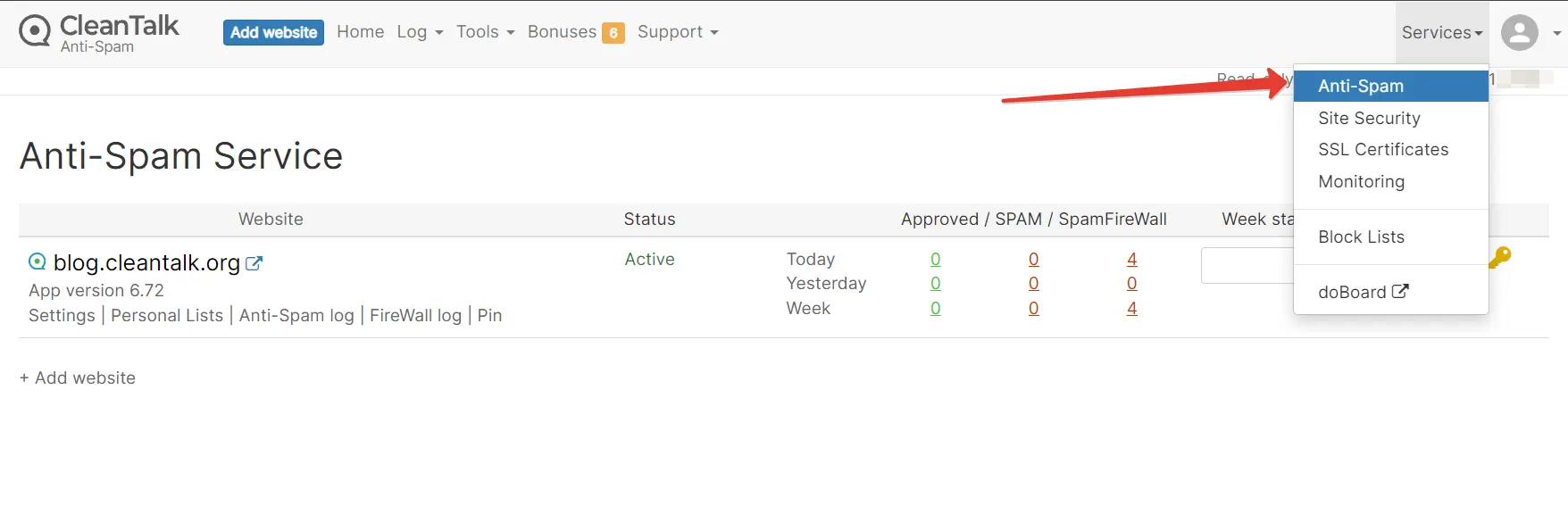
1. Log in to your Anti-Spam Dashboard → Select "Anti-Spam" from the "Services" menu.
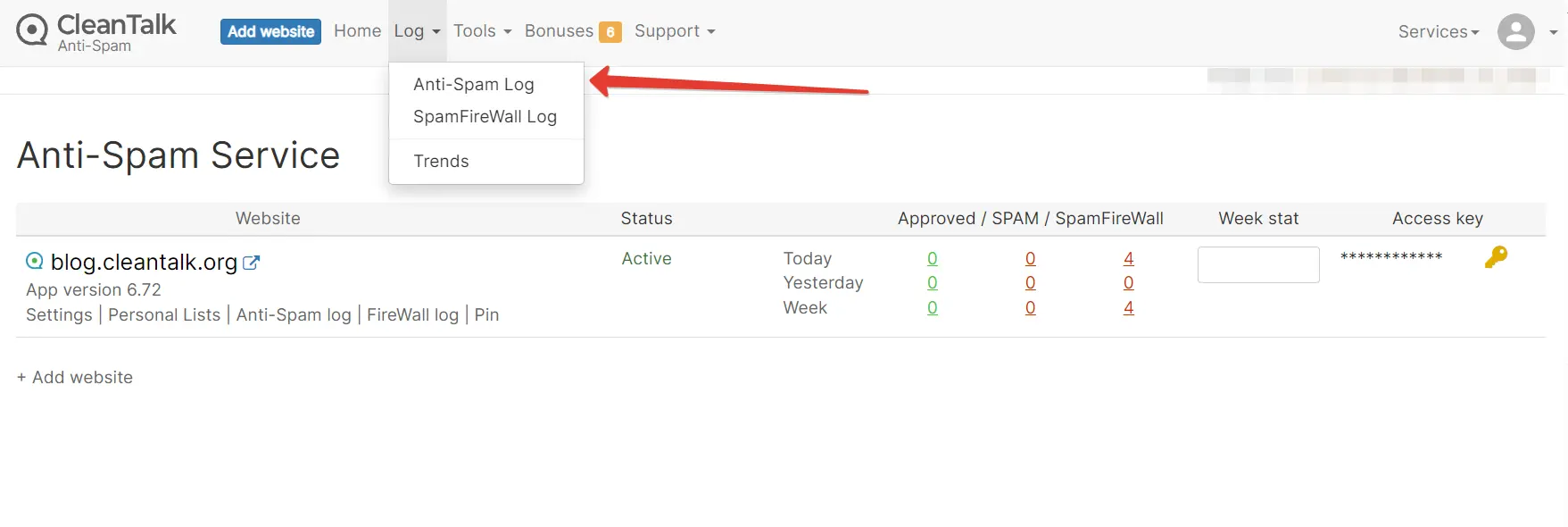
2. Navigate to your Anti-Spam Log within the dashboard.
3. On the Anti-Spam Log page, you can use the following filters:
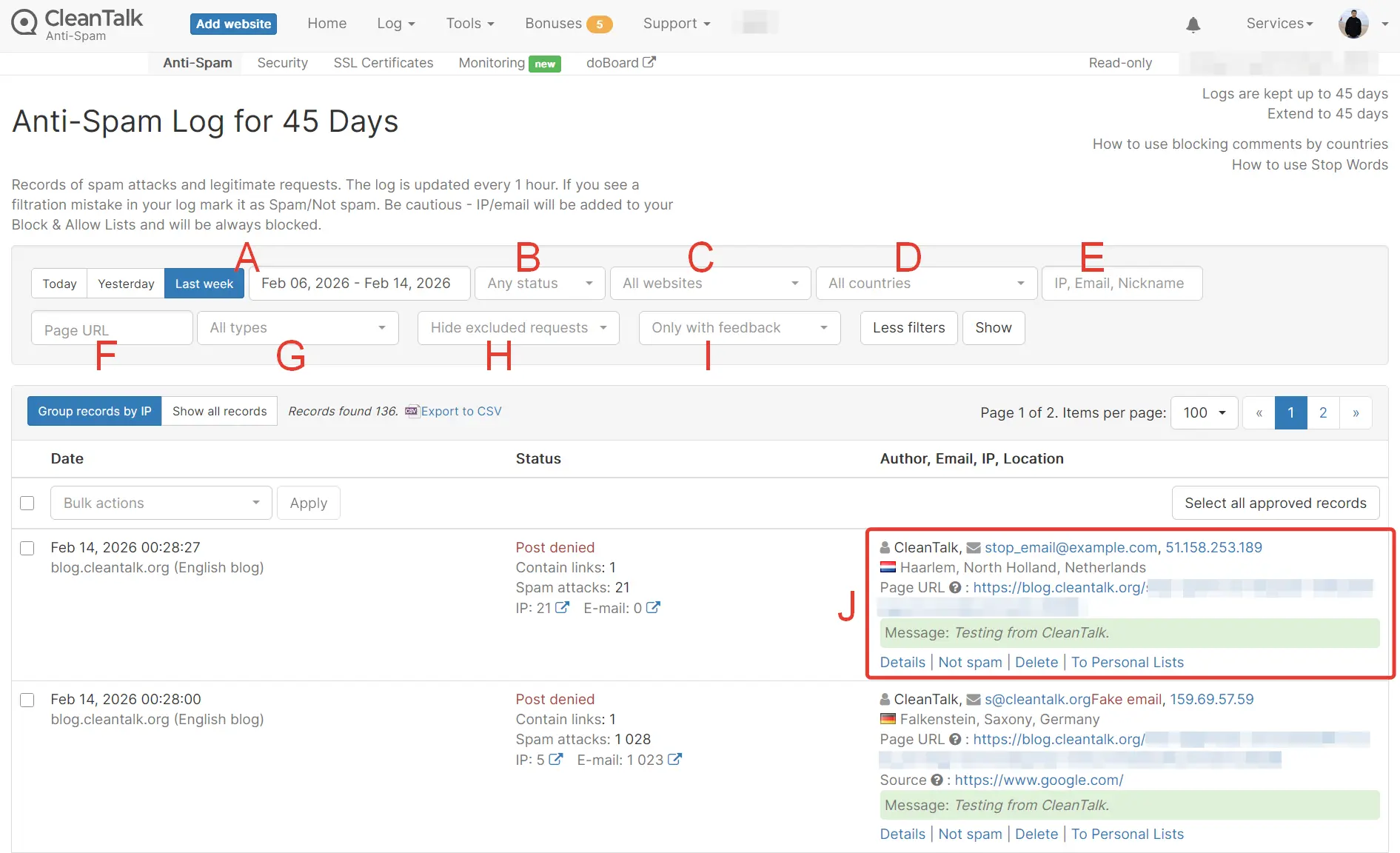
The following possibilities are available for you in the Anti-Spam Log:
A — Time Period: Select the timeframe for the records you wish to view.
B — Status: Filter records by their resolution: Any status, Denied, or Approved.
C — Websites: Filter records by a specific website in your account.
D — All Countries: Filter records by the sender's country of origin.
E — Search (IP, Email, or Nickname): Filter records by specific user data. You can perform advanced searches using email masks.
Search Rules: To represent any number of characters, use the asterisk symbol *. Please note that your search expression must contain at least one @ and at least one "." (dot).
| Mask Example | What it finds | Matches (Examples) |
| *john*@*.* | Any email containing "john" in the name | xmpljohn@yahoo.com, john6545@me.com |
| john*@*.* | Emails starting with "john" | johnny.v@gmail.com |
| *john@*.* | Names ending with "john" | bigjohn@domain.com |
| *john*@*is*.*u | Combined search (name + domain) | john11@vista.ru, atjohn@is74.eu |
F — Page URL: Filter records by the specific page URL where the request occurred.
G — Type: Filter by the type of request (e.g., Registration, Order, Search, Contact Form).
H — Hide Excluded Requests: Use this toggle to show or hide records marked as "Excluded."
Excluded From Spam Filters
You may notice the status "Excluded from spam filters" for certain records. This indicates that the request was logged for your information but was not processed by the Anti-Spam filtering. This typically happens for the following reasons:
- Invalid POST Requests: Bots often use generic templates to target common website forms (such as contact or registration forms). If a bot sends a request using a template that does not match your website's actual form structure — or if it targets a page that contains no forms at all — the request is inherently invalid. Because your website cannot "see" or process these mismatched requests as actual submissions, the Anti-Spam Service logs the attempt but does not perform a full filter check.
- Trusted User Bypass: This occurs when the "Don't check trusted user's comments" option is enabled in your settings. If a visitor has three or more previously approved comments on your website, the Anti-Spam Service will automatically bypass checks for their future submissions.
I — Only with feedback: only display the records marked as Spam / Not Spam. You can learn more about this feature here.
J — Record info:
- Sender's nickname, email, and IP addresses.
- Sender's country.
- Page URL: The page on your website where the visitor filled out and submitted the form.
- Message: text of the visitor's comment.
- Details: see item 4 below.
- Spam / Not Spam: Correct the anti-spam service decision if a request was wrongly blocked or approved.
- Delete: Permanently delete the record.
- To Personal Lists — go to your website Personal Lists page.
4. Record Details
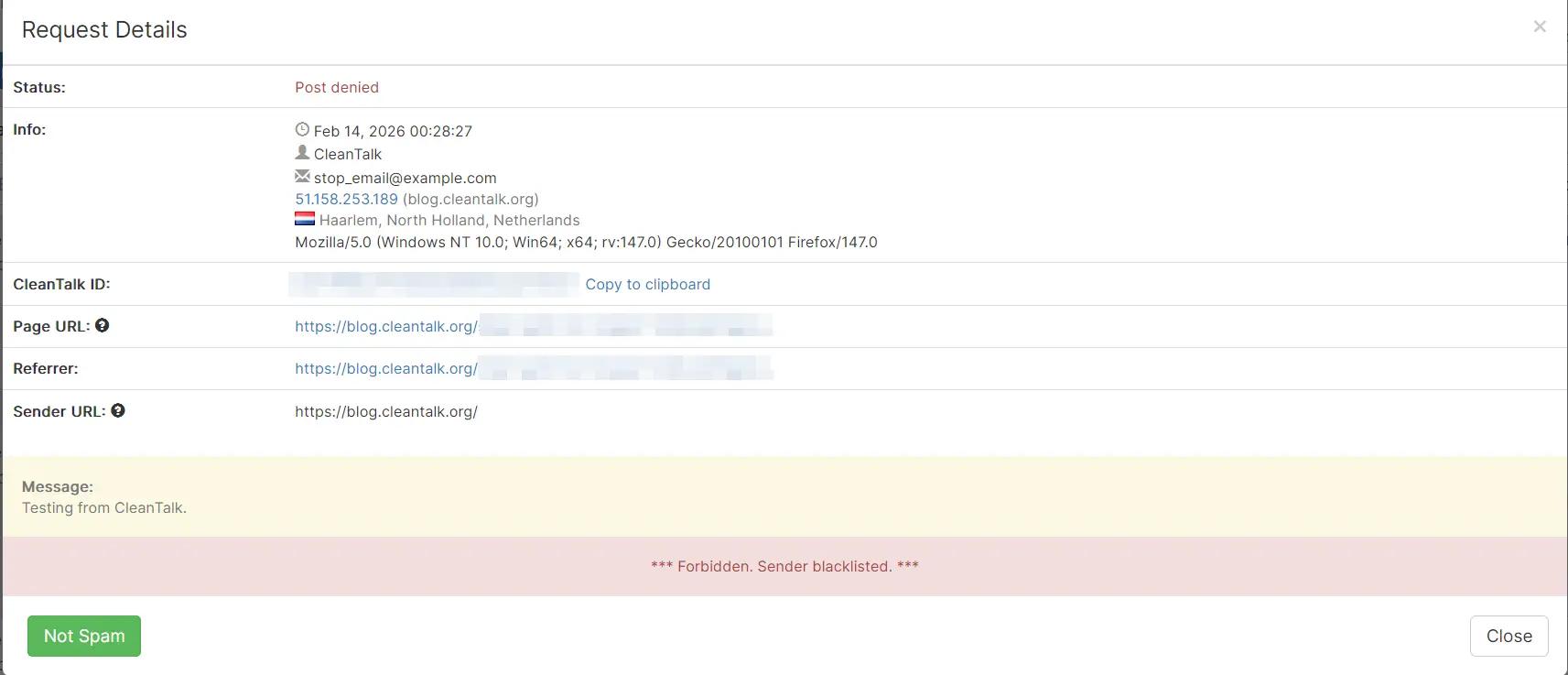
Clicking "Details" provides a deep dive into the request: block reason, message body, form validation results, and technical headers.
Note: The "Sender URL" field corresponds to the "Website" field in standard forms (like the WordPress comment form). If the field is empty, the user left it blank, or the spammer was blocked instantly by IP/Email reputation.

This field may be empty if a visitor did not fill out the "Website" field, or if the visitor was a known spammer already blacklisted by their IP or email address (in which case, no additional tests were required).
If you have questions regarding a specific record, please send us the CleanTalk ID along with your inquiry through our Ticket System here.
Using the SpamFireWall Log
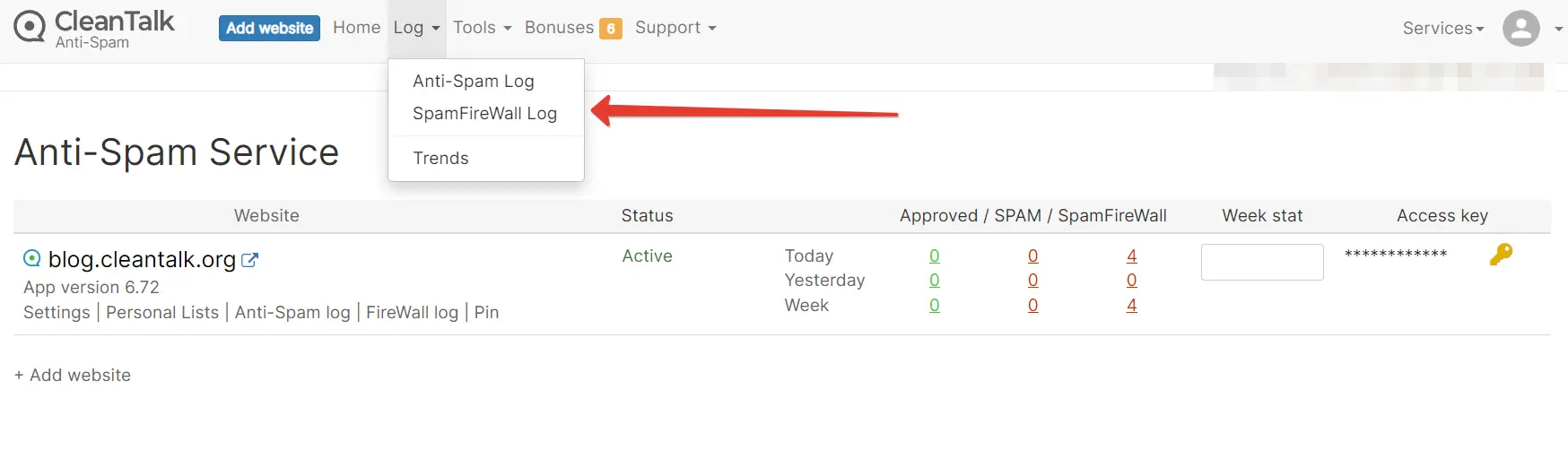
5. Access the SpamFireWall Log from your Anti-Spam Dashboard.
6. Available filters:
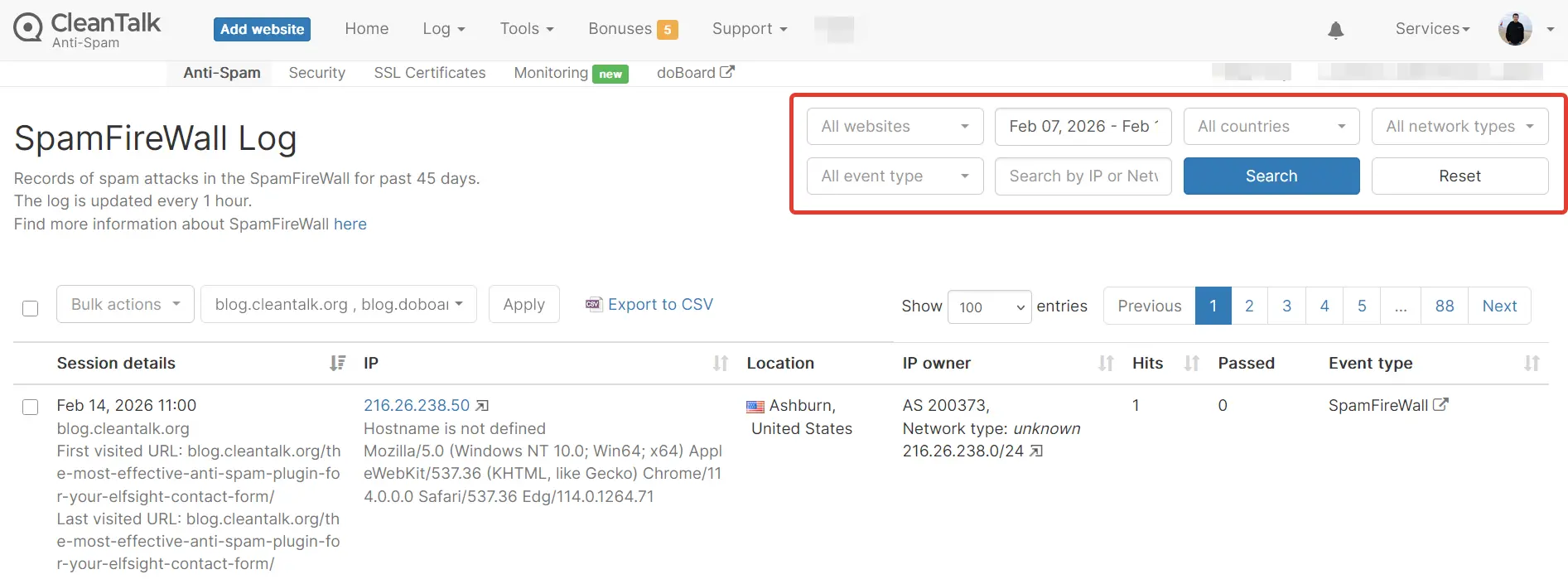
The following possibilities are available for you in the SpamFireWall Log:
- Website: Select the specific website to see the logs.
- Time Period: Choose the reporting interval.
- Country: Filter traffic by the origin country.
- Network Types: Select which types of IP networks to display (e.g., ISP, VPN, Hosting, etc.).
- Event Type: Select the specific reason for the block to be displayed (e.g., SpamFireWall, AntiFlood, Anti-Crawler, or Personal Lists).
- Search by IP / Network: Check all SpamFireWall events for a specific IP address or network.
List of Visited URLs of Your Visitors
(For the WordPress Plugin Only)
This feature allows you to see the path a visitor took on your site before submitting a form. This is useful for analyzing user behavior and popular entry points.
How to Enable:
- Go to your WordPress Admin → Settings → Anti-Spam by CleanTalk.
- Click Advanced settings.
- Check the box "Store Visited URLs" and click Save Changes.
How to View:
- Open your Anti-Spam Dashboard.
- Click the "Log" → Ant-Spam Log.
- Click "Details" for any specific request.
- The visitor's navigation history will be displayed in the details view.
3. Click the link "Details" in any row of any request.

4. You will be able to see the source and the list of URLs of the visitor, in addition to other details of the post.

It would also be interesting
- How do I report a missed spam bot or incorrect filter?Description of the process for sending a report about a missed spam bot or an incorrect filter If you...
- Extra Package for CleanTalk Security ServiceExtra Package for Security Service 45 Days Log Backend (PHP) Logs User Actions Log (Audit) Custom...
- CleanTalk Security. How to use Security FireWall LogHow to Use Security FireWall Log 1. First go to your Security Dashboard. Choose "Site Security"...